Oracle MICROS Simphony Integration: Connecting On-Premise POS with Online Ordering & Cloud (2026 Guide)
Oracle MICROS Simphony is one of the most widely deployed restaurant point-of-sale (POS) platforms in the world — powering everything from single cafes to global hotel and food-service chains. But here's the problem most restaurant operators run into: their on-premise Simphony POS lives in a silo, disconnected from the online ordering apps, delivery platforms, loyalty programs, and cloud analytics that modern customers expect.
In this guide, we break down exactly how Oracle MICROS Simphony integration works — the architecture, the APIs, the real-world challenges, and how a middleware platform bridges the gap between on-premise hardware and the cloud. This is the same approach we use when building production integration platforms for multi-branch restaurant groups.
Why Oracle MICROS Simphony Integration Is Hard
Simphony was originally architected as an enterprise on-premise system. Even with Oracle's cloud offerings (Simphony Cloud), many restaurants still run property-level POS servers and Check & Posting (CAPS) services locally for resilience. That creates a fundamental challenge: how do you let an internet-based ordering app talk to a POS sitting behind a restaurant's firewall?
- On-premise POS systems are not exposed to the public internet for security reasons.
- Menu data, pricing, and modifiers live inside the Simphony EMC (Enterprise Management Console) and must stay in sync.
- Orders created online must post to the correct revenue center, employee, and order type.
- Payments, table settlement, and check closing must reconcile precisely or accounting breaks.
- Multi-branch operations multiply every one of these problems.
The Simphony Transaction Services API (STSG)
The core of any Simphony integration is the Simphony Transaction Services Gateway (STSG) — Oracle's API layer that lets external systems create and manage checks, query menus, and post payments. It exposes operations for retrieving configuration, opening checks, adding menu items, applying discounts, and settling payments.
At a high level, an integration uses these key capabilities:
- 1GetConfigurationInfo — pull revenue centers, employees, tender media, and order types.
- 2GetMenuItems — retrieve the menu, prices, and modifiers to sync to your online platform.
- 3PostTransactionEx — open a check, add items and modifiers, and post it to the POS.
- 4Payment & settlement calls — apply tenders and close the check automatically.
// Simplified example: posting an online order to Simphony
{
  "revenueCenterRef": 1101,
  "checkEmployeeRef": 90001,
  "orderTypeRef": 3,           // e.g. "Online Pickup"
  "menuItems": [
    { "menuItemId": 200145, "quantity": 2, "modifiers": [200980] },
    { "menuItemId": 200162, "quantity": 1 }
  ],
  "tenders": [
    { "tenderMediaRef": 12, "amount": 24.50 }  // Online payment
  ]
}
Engineering tip
Never hardcode revenue center, employee, or tender references. Pull them dynamically with GetConfigurationInfo per property — they differ across branches and change over time. Hardcoding is the #1 cause of multi-branch integration failures.
The Middleware Architecture That Makes It Work
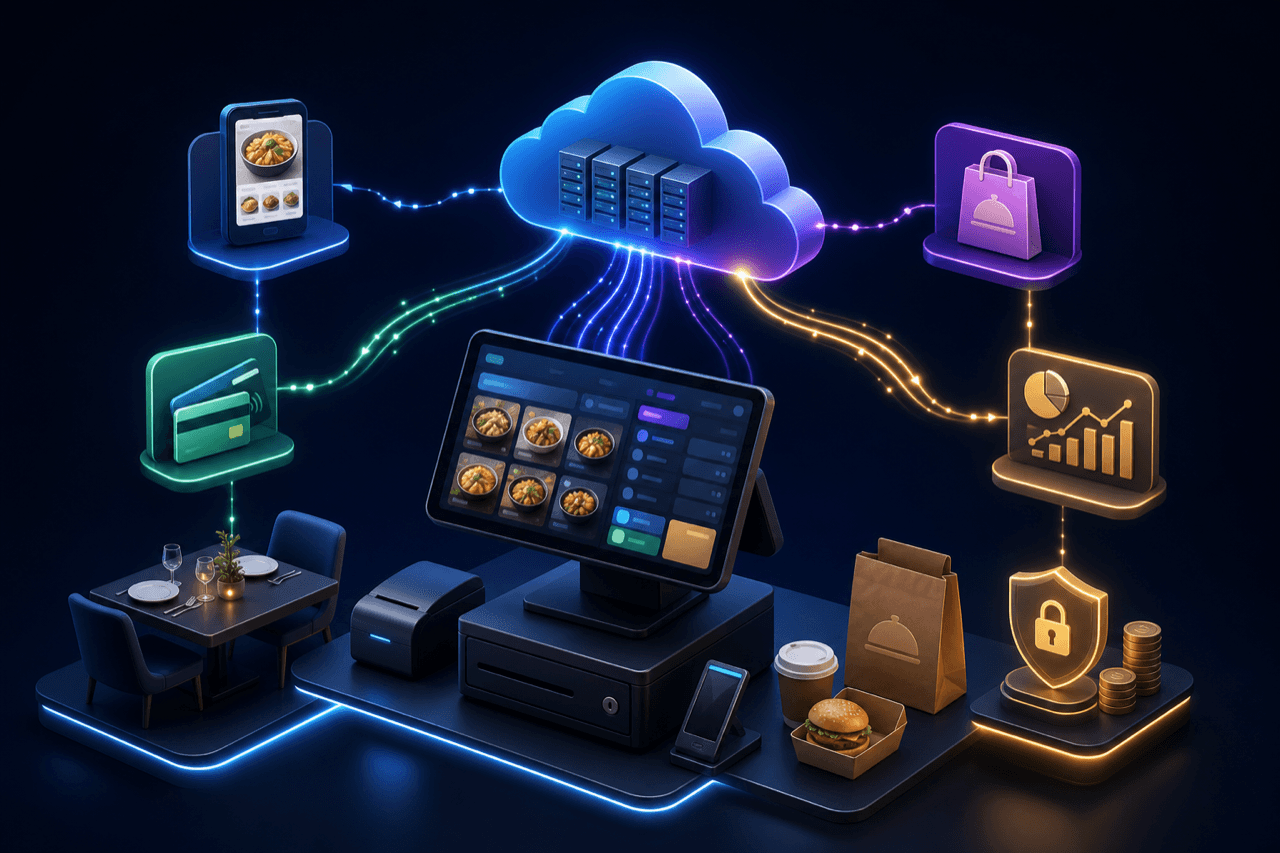
Because the POS can't be exposed publicly, the proven pattern is a cloud middleware layer that sits between your customer-facing apps and the on-premise Simphony system. The middleware handles authentication, menu sync, order translation, and status tracking.
A typical production architecture looks like this:
- Customer apps (web, mobile, kiosk) → send orders to the cloud middleware API.
- Cloud middleware → normalizes the order, validates against the synced menu, and queues it.
- On-premise connector/agent → securely polls or maintains an outbound connection to the middleware (no inbound firewall ports needed) and calls the local STSG.
- Simphony POS → creates the check, prints to the kitchen, and returns status.
- Status flows back up the chain → the customer sees real-time order tracking.
This outbound-connection pattern is critical: it means restaurants don't have to open inbound firewall ports, which keeps IT and security teams happy while still enabling real-time online ordering.
Menu Synchronization: The Hidden Complexity
Menus are deceptively hard. A single Simphony menu item can have condiment groups, forced modifiers, price tiers by revenue center, time-based availability, and combo meal logic. Your online platform must mirror all of this, or customers will order combinations the kitchen can't fulfill.
- 1Sync menu items, prices, and modifier groups from Simphony on a schedule (and on-demand).
- 2Map Simphony's forced/optional modifier rules to your online UI so invalid orders are impossible.
- 3Respect revenue-center-specific pricing — the same burger may cost differently at dine-in vs delivery.
- 4Handle 86'd (out-of-stock) items in near real time to avoid refunds and angry customers.
Payments, Table Settlement & Auto-Closing Checks
For pickup and delivery, online payment is captured by your payment gateway (Stripe, Checkout.com, regional processors) and then posted to Simphony as a tender so the check auto-closes. For dine-in 'pay at table' flows, the integration retrieves the open check, lets the guest pay from their phone, posts the payment, and closes the table — no waiter needed.
Reconciliation matters
Always post the online payment as a distinct tender media type (e.g. 'Online Card') so finance can reconcile online revenue separately from in-store card payments. This single decision saves countless accounting headaches.
Multi-Branch & Cloud Analytics
Once orders flow through a central middleware, you get a powerful side benefit: unified, real-time analytics across every branch. Sales by location, peak-hour analysis, menu item profitability, and order-type performance all become queryable from one cloud dashboard — something on-premise Simphony alone can't easily provide.
Common Pitfalls to Avoid
- Skipping idempotency — network retries can double-post orders. Always use idempotency keys.
- Ignoring time zones — multi-region chains will mis-report sales without correct property time zones.
- Poor error visibility — build a monitoring dashboard so failed orders are caught instantly, not discovered via customer complaints.
- Hardcoded configuration — as noted, always pull config dynamically per property.
Conclusion: Turn Your Simphony POS Into a Connected Platform
Oracle MICROS Simphony integration unlocks online ordering, mobile payments, loyalty, and cloud analytics — without ripping out the POS your staff already know. The key is a secure cloud middleware layer, dynamic configuration, rock-solid menu sync, and clean payment reconciliation.
At Vocxa, we build custom Oracle MICROS Simphony integration platforms that connect on-premise POS with the cloud — online ordering, payments, loyalty, and multi-branch analytics, all in one.
Frequently Asked Questions
Can Oracle MICROS Simphony integrate with online ordering systems?
Yes. Using the Simphony Transaction Services Gateway (STSG) API combined with a secure cloud middleware layer, you can connect on-premise Simphony POS to online ordering websites, mobile apps, and delivery platforms while keeping the POS behind the firewall.
Do I need to expose my POS to the internet for Simphony integration?
No. The recommended architecture uses an on-premise connector that makes outbound connections to a cloud middleware, so no inbound firewall ports are required. This keeps your POS secure while enabling real-time online ordering.
How does menu synchronization work with Simphony?
The integration pulls menu items, prices, modifier groups, and availability from Simphony (via GetMenuItems and configuration APIs) on a schedule and on-demand, mirroring all modifier rules and revenue-center-specific pricing to your online platform.
Does Simphony integration support multiple branches?
Yes. A central cloud middleware can route orders to the correct property and revenue center, while aggregating real-time sales and analytics across all branches in a single dashboard.
Build It With Vocxa
We build custom integration platforms, AI apps, and software for startups and SMEs. Let's turn this into reality for your business.